
January 30, 2026
IT Cost Optimization Strategies for Cost Control & Competitive Edge
Learn how IT cost optimization helps reduce waste, improve efficiency, and align technology spending with business goals for long-term success.


Buying more compliance tools without fixing your IT onboarding process can actually increase your audit risk. Software stacks often hide the access and identity gaps that auditors notice first.
IT compliance requirements get treated, most often, as a shopping list - buy the right software, tick the right boxes, done. In practice it rarely works that way, and the gap between that assumption and what actually holds up under audit is where most of the trouble starts.
Buying more security or compliance software feels like the responsible move, and in a narrow sense it is. But the real risk, more often than not, tends to show up earlier - when a new employee gets access or an account without anyone following a clear system. That's when audit issues start piling up quietly, even while the software stack looks solid on paper.
So the point isn't that tools don't matter. It's that compliance depends, first, on every person who joins the team being set up correctly from day one. Skip that step, or handle it inconsistently, and you may end up paying for tools that actually obscure the problems an auditor cares about most.

Onboarding is where most access and identity gaps begin, even though most businesses put their attention into compliance regulations and security tools instead.
New hires usually get access to systems, files, and applications fairly quickly, and if that process is manual or inconsistent, some people end up with more access than they need while others get left out. Left unaddressed, that imbalance builds into a patchwork of permissions that's genuinely hard to track.
What auditors are actually looking for is a clear record of who has access to what and how that access is managed, and when onboarding is weak, even strong compliance software can't make up for the confusion. If anything, it can make the real problems harder to locate.
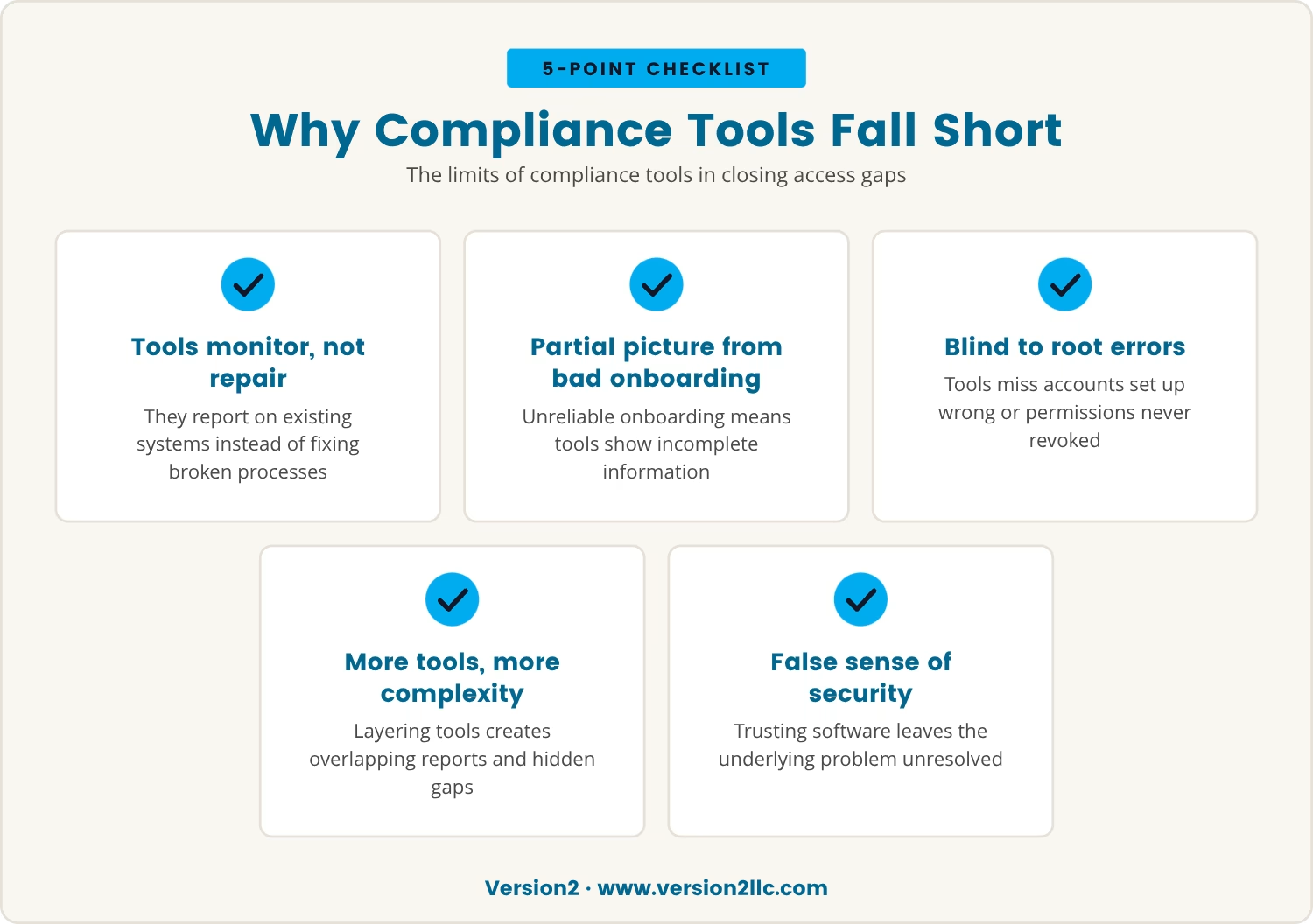
Adding more compliance tools feels like it should close the gaps, but most of those tools are built to monitor or report on systems that already exist - not to repair a process that's broken underneath.
When IT onboarding isn't reliable, the picture those tools give you is probably only partial. They can track whatever they're told to track, but they generally can't spot an account that was set up wrong in the first place, or a permission that was never removed.
That's really the trap: the more tools layered on top, the more complex the environment gets, and instead of clarity you end up with overlapping reports and gaps that slip through unnoticed. The risk, then, is trusting the software to catch everything when the root problem is still sitting there untouched.
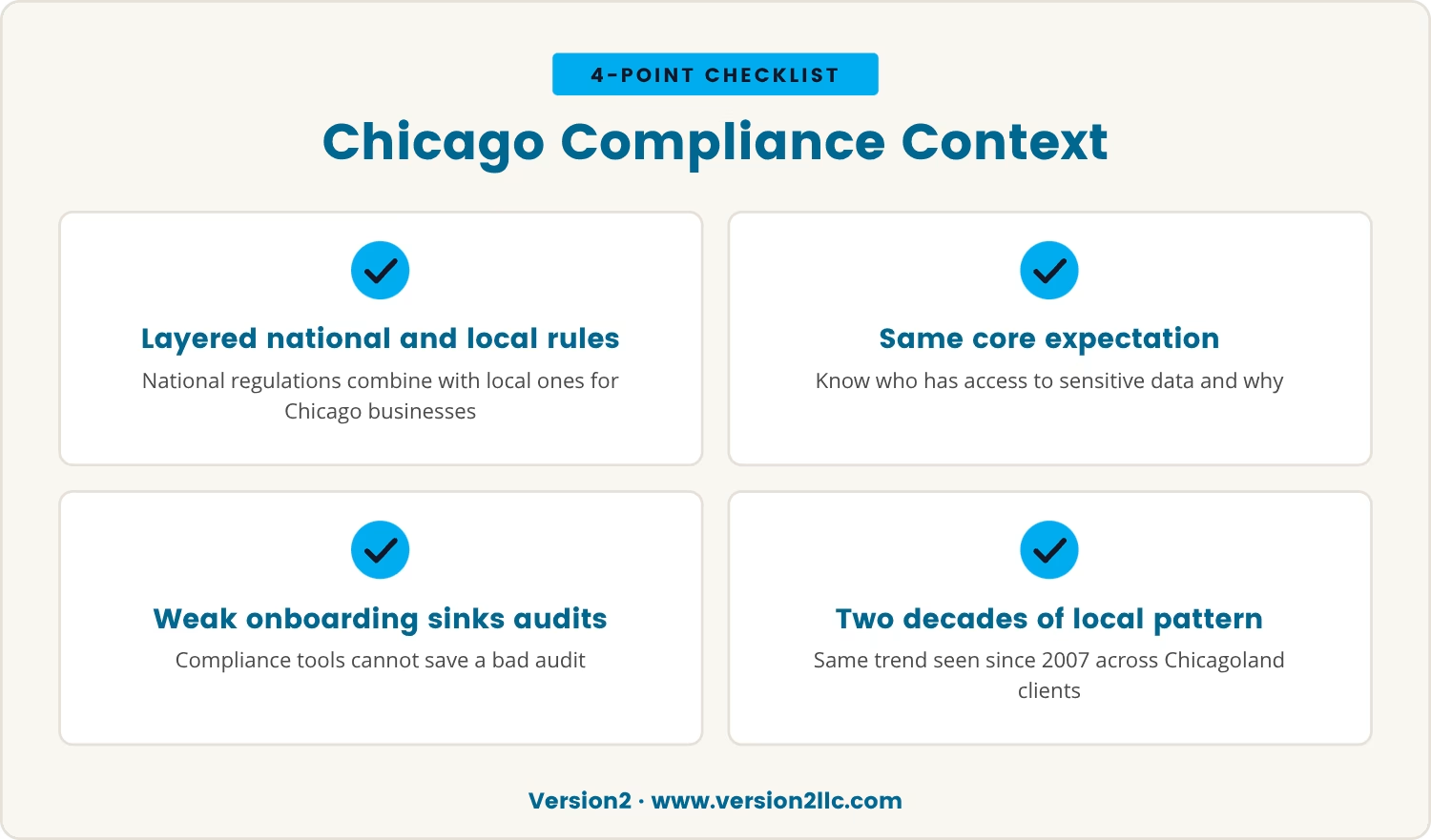
For businesses in Chicago, IT compliance requirements get shaped by national rules layered over local ones, and whether you're handling health information, payment data, or customer records, the penalties for getting it wrong tend to be steep.
Still, whichever standard applies - HIPAA, PCI DSS, or something else - the core expectation stays the same: you need to know who has access to sensitive data and why. If onboarding isn't airtight, an audit can go badly no matter how many compliance tools sit in the stack.
We've been serving Chicagoland for over 20 years, since 2007, and the pattern holds across that whole stretch of client relationships - some retained 18+ years - that the businesses balancing cybersecurity against daily operations successfully are the ones treating onboarding as seriously as the software itself.
A weak onboarding process can generate several audit problems on its own, even alongside heavy investment in compliance management tools. A few of the more common ones:
Each of those can trigger an audit finding on its own, even while the compliance software reports everything as green.
We think about onboarding the same way across the client base we support - healthcare practices, financial firms, manufacturers - because the entities and the applicable rules differ, but the sequence of who-gets-what-access-when doesn't. A few elements tend to make the difference when we walk through a new hire setup with a client.
Every new hire moving through the same steps, documented at each stage, cuts down on confusion and makes the audit itself far less painful.
Granting access by job role rather than individual request keeps unnecessary permissions - and the risk that comes with them - out of the picture.
Automating account and permission setup reduces human error and keeps the process consistent from one hire to the next.
Access should be updated or removed the moment someone leaves or changes roles - that's what keeps orphaned accounts from accumulating.
Periodic checks of accounts and permissions tend to catch problems well before they turn into audit findings.
Every action taken during onboarding and offboarding needs to be logged somewhere easy to retrieve when an audit actually happens.
More compliance software can feel like more control, but it often does the opposite - each new tool arrives with its own dashboard, reports, and alerts, and that volume alone can overwhelm a compliance team.
Rather than solving the underlying problem, that stack of tools can create a false sense of security. Everything might look compliant on the surface, while the gaps opened during onboarding sit there untouched.
Auditors, for their part, are trained to look past the dashboards and into how the process actually runs day to day. If onboarding is weak, no amount of software sitting on top is likely to cover that up.
A compliance checklist probably works better starting with onboarding rather than ending with it. When we build one out with a client, it tends to come back to the same handful of steps, regardless of which vertical they're in:
Leaning on software to solve compliance problems without fixing onboarding underneath risks spending money on tools that never touch the actual issue. The cost isn't only financial - it's audit findings, penalties, and the dent to reputation that follows.
A solid onboarding process isn't as visible as a new compliance tool, but it's what an auditor tends to look for first, and if that foundation is weak, no amount of software sitting on top makes up for it.

Many businesses with 10 to 100 employees in Chicago invest in compliance software, but still struggle with audit issues because their onboarding process is inconsistent. At Version2, we understand how frustrating it is to spend money on tools and still worry about hidden risks.
If you want to see how a reliable onboarding process can strengthen your compliance program, our team is ready to talk about your current setup and what could make it stronger.
If you’re not satisfied with Version2’s onboarding in the first three months, just let us know and we’ll refund your onboarding fee—no questions asked.
Watch for inconsistent access permissions, accounts still active after someone has left, or missing documentation for user accounts. Finding any of these is a decent sign your onboarding process is putting compliance at risk.
Compliance standards are guidelines or best practices set by industry groups, while compliance regulations are legal requirements set by government agencies. Both matter, but only regulations carry legal penalties for falling short.
Once a year is the usual minimum, though quarterly reviews tend to serve organizations better. More frequent audits catch issues earlier and keep records current.
A compliance framework is a structured set of policies and procedures guiding how an organization meets its compliance requirements. Having one in place tends to make audits more consistent and considerably easier to manage.
Automation handles repetitive tasks well - account provisioning and deprovisioning among them - but it shouldn't replace human oversight entirely. Manual checks are still what catch the exceptions and confirm the process is actually working as intended.

January 30, 2026
Learn how IT cost optimization helps reduce waste, improve efficiency, and align technology spending with business goals for long-term success.

January 26, 2026
Learn how IT infrastructure management helps your business stay secure, efficient, and scalable with best practices, tools, and expert strategies.

January 20, 2026
Learn how IT support and maintenance services help reduce downtime, improve reliability, and keep your business systems running efficiently and securely.
