Five recurring gaps in AI governance often let LLM data privacy fail, even when a company has a written policy. Knowing these gaps lets leaders audit their real risk instead of assuming documentation alone keeps them safe.
AI security risks are not just a technical problem—they can quickly become a business crisis. When sensitive data leaks or is misused by artificial intelligence, companies face real costs: lost trust, regulatory fines, and even lawsuits. A written AI policy might look like protection, but on its own, it often leaves surprising gaps.
A single overlooked weakness in how you manage large language models (LLMs) can expose confidential information, even if you believe your documentation is solid. Many leaders assume that having an AI governance policy means their data is safe, but the reality is more complicated.
AI systems are only as secure as the details behind their daily use. If you want to keep your business safe, you need to know where policies break down in practice—especially when it comes to LLM data privacy.
The illusion of safety: Why written policies aren’t enough
It’s easy to feel secure once you’ve put an AI policy on paper. This section looks at why that sense of safety can be misleading.
A written policy is only the starting point for protecting sensitive information. In practice, employees may not follow every rule, or they might not fully understand how those rules apply to new AI tools. This gap between policy and reality is where many data privacy failures begin.
Even the best-drafted documents can’t predict every way artificial intelligence will be used in your organization. As teams experiment with generative AI, new risks appear that the original policy never covered. When these risks go unnoticed, private business data can slip through the cracks.
How AI governance frameworks can fall short
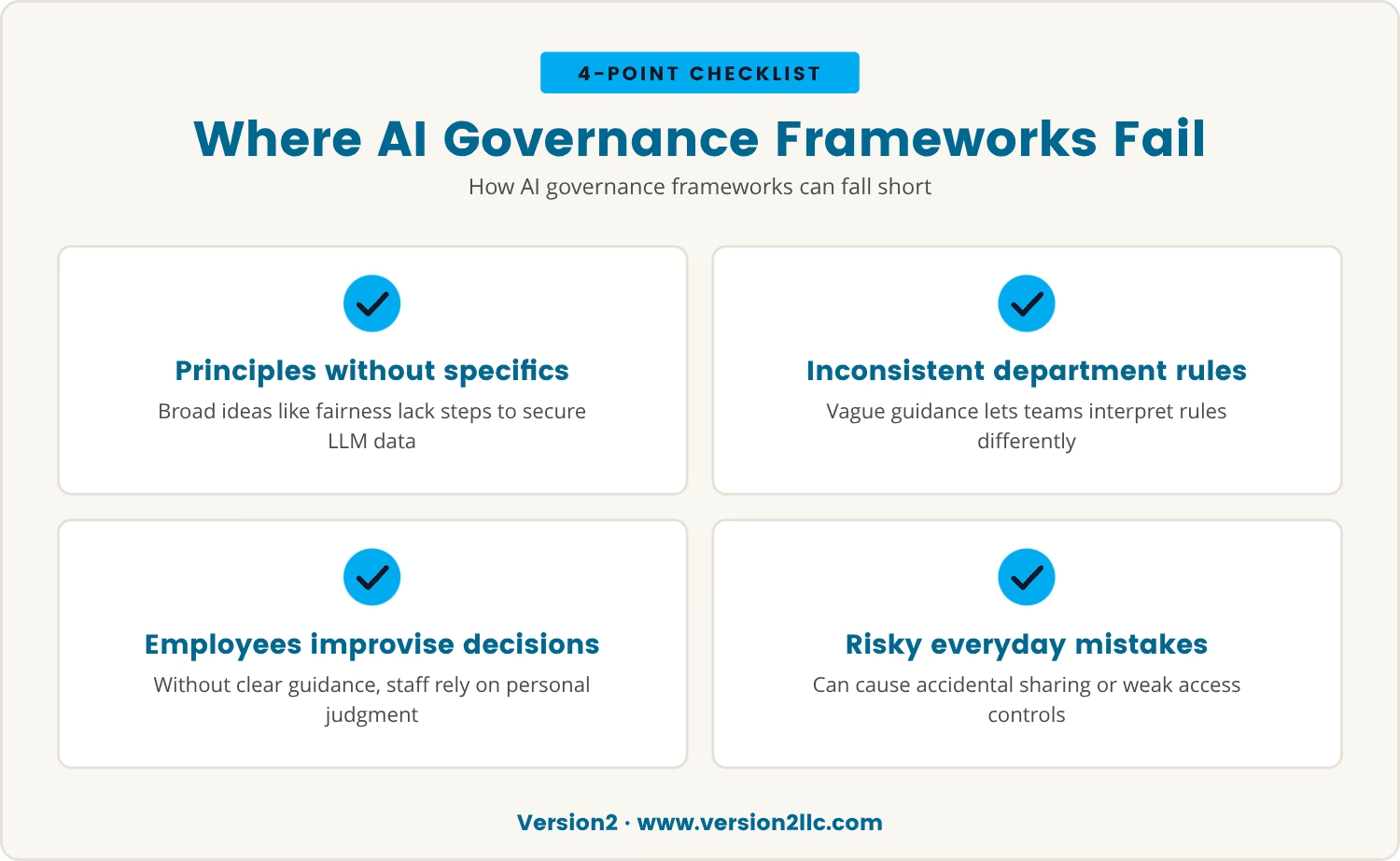
AI governance is meant to guide safe and ethical use of AI, but frameworks often miss the mark in real-world settings.
Many frameworks focus on broad principles—like fairness or transparency—without spelling out the exact steps needed to secure LLM data privacy. This leaves room for interpretation, and different departments may apply the rules in inconsistent ways.
Without clear, practical guidance, employees may rely on their own judgment when using AI tools. This can lead to accidental data sharing, weak access controls, or improper handling of sensitive inputs. Over time, these small lapses add up to major vulnerabilities.
Five recurring gaps in AI security risks for Chicago businesses
Even with a written policy, certain weaknesses keep showing up. Here are five non-obvious gaps that often let LLM data privacy fail.
1. Untracked shadow AI usage
Employees sometimes use AI tools outside approved channels. These "shadow" uses can bypass official controls, making it hard to monitor what data is being shared or processed.
2. Incomplete data input restrictions
Policies may not clearly define what types of data are safe to enter into AI systems. Without strict input rules, sensitive information can end up in training data or outputs.
3. Overlooked third-party integrations
AI models often connect with outside platforms or plugins. If these integrations aren’t reviewed for security, they can become a backdoor for data leaks.
4. Lack of ongoing employee training
Initial training is common, but regular refreshers are rare. As AI tools evolve, employees need updated guidance to avoid new risks.
5. Weak audit and monitoring processes
Many companies set policies but don’t actively check if they’re being followed. Without real-time monitoring or audits, violations can go unnoticed for months.
The hidden cost of ignoring LLM data privacy
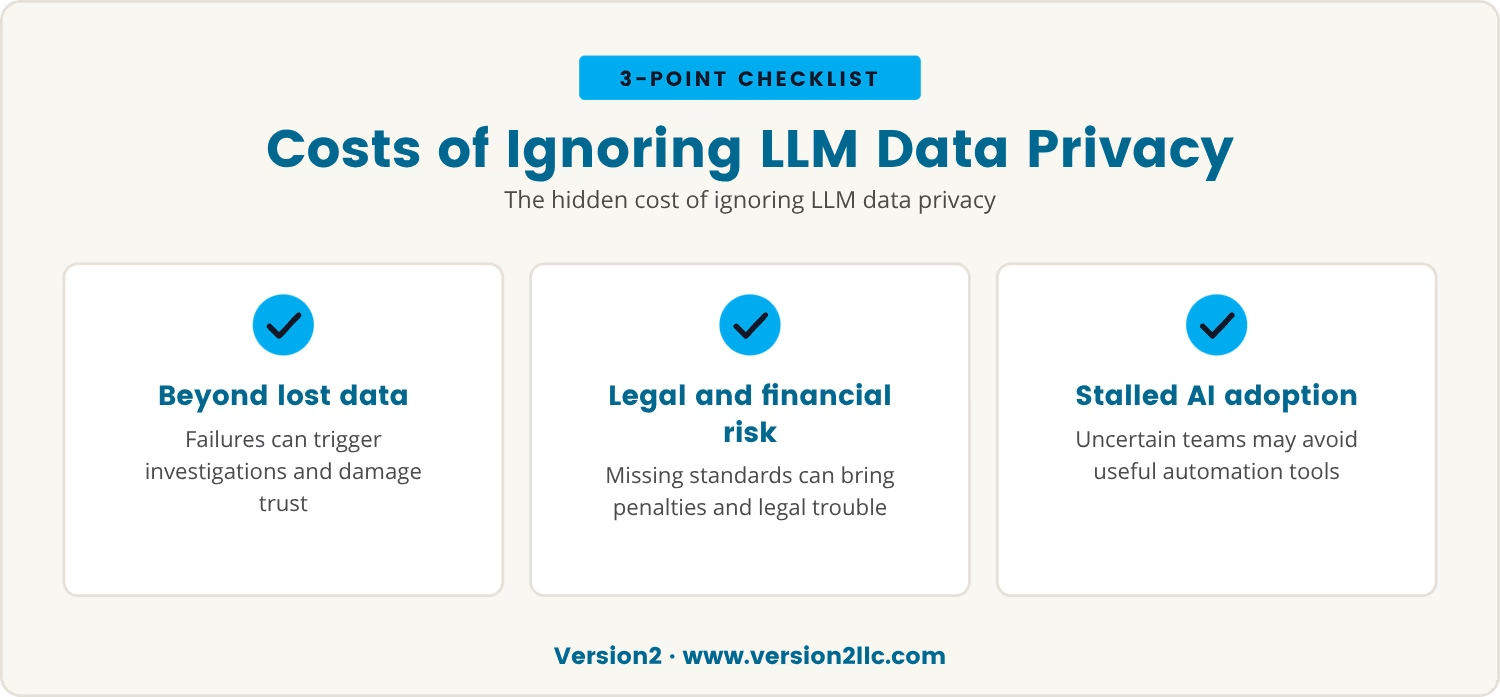
When these gaps go unaddressed, the consequences can be severe. Data privacy failures don’t just result in lost information—they can trigger regulatory investigations, damage your reputation, and erode client trust.
For businesses in Chicago, the stakes are even higher. Local regulations and industry standards may require stricter controls over how AI systems handle personal or confidential data. Failing to meet these standards can lead to legal trouble and financial penalties.
Ignoring these issues also slows down your ability to use AI safely. If your team is unsure about what’s allowed, they may avoid using helpful AI tools altogether, missing out on valuable automation and insights.
Practical steps to strengthen your AI governance
Knowing where policies fail is the first step. Here’s how you can start closing the gaps:
Map your AI usage: Identify every place AI tools or language models are used, including unofficial ones.
Set clear input rules: Define exactly what data can and cannot be shared with AI systems.
Review third-party connections: Regularly check all integrations for security and privacy risks.
Schedule ongoing training: Make sure employees get regular updates on AI security and privacy practices.
Implement active monitoring: Use tools or audits to track compliance and catch violations early.
Each of these actions helps turn your written policy into real protection. They also make it easier to spot new vulnerabilities before they become serious problems.
Why regular audits matter more than ever
Auditing isn’t just about checking boxes—it’s about finding the weak spots that policies miss. Regular reviews help you catch shadow AI use, outdated training, or risky integrations before they lead to data loss.
A strong audit process also builds confidence with clients and regulators. When you can show that your AI risk management is active and ongoing, you’re less likely to face fines or reputational harm if something does go wrong.
Ask yourself: When was the last time you reviewed how your team actually uses AI tools, not just what the policy says?
Closing the gap between policy and practice
A written AI policy is a good start, but it’s not enough on its own. The real work happens in the details—tracking usage, updating training, and actively monitoring for risks.
Leaders who understand these five recurring gaps can move from assuming they’re protected to knowing they are. By turning policy into action, you protect your business, your clients, and your reputation for the long term.
Move from policy to real protection with Version2
Many businesses with 10 to 100 employees have a written AI policy but still face hidden risks that documents alone can't fix. At Version2, we know how easy it is for gaps to appear between policy and daily practice.
If you want to see how we approach closing these gaps—or want to talk through your own setup—our team is ready to help you turn written rules into real security.
Worried your policy has hidden gaps?
If you’re not satisfied in your first three months with us, we’ll refund your onboarding fee—no questions asked.
How can I tell if my AI security policy is actually being followed?
Start by mapping out all the ways your team uses AI tools, both official and unofficial. Then, use monitoring tools or regular audits to check if employees are following the rules in daily practice. Look for gaps between what’s written and what’s really happening.
What are some signs that my business has shadow AI usage?
If you notice employees using unapproved AI-powered apps or browser extensions, or data showing up in places it shouldn’t, you may have shadow AI use. Regularly reviewing software logs and talking with staff can help uncover these hidden risks.
How often should I update employee training on AI security risks?
Employee training should be refreshed at least once a year, and whenever you introduce new AI systems or update your policy. Ongoing reminders and short refresher sessions help keep security best practices top of mind.
What should I look for in third-party AI integrations?
Check if the integration has strong access controls, clear data handling policies, and a record of responding to security threats. Make sure you understand what data is shared and how it’s protected before connecting any new tool.
Can automation help with AI risk management?
Yes, automation can make it easier to monitor AI usage, detect policy violations, and respond quickly to incidents. Automated tools can flag unusual activity and help enforce your governance framework without adding extra work for your team.
Jeff founded Version2, LLC in 2007 to deliver enterprise-level IT solutions, specializing in virtualization and networking. During his free time he enjoys the outdoors while golfing and snowmobiling.
Spotting the right moment for outside help means you avoid wasting money on consultants you don’t need—or underfunding projects that will never get off the ground.
Businesses that overlook their meeting room network will keep facing dropped calls and frozen screens, no matter how many new video platforms they try.